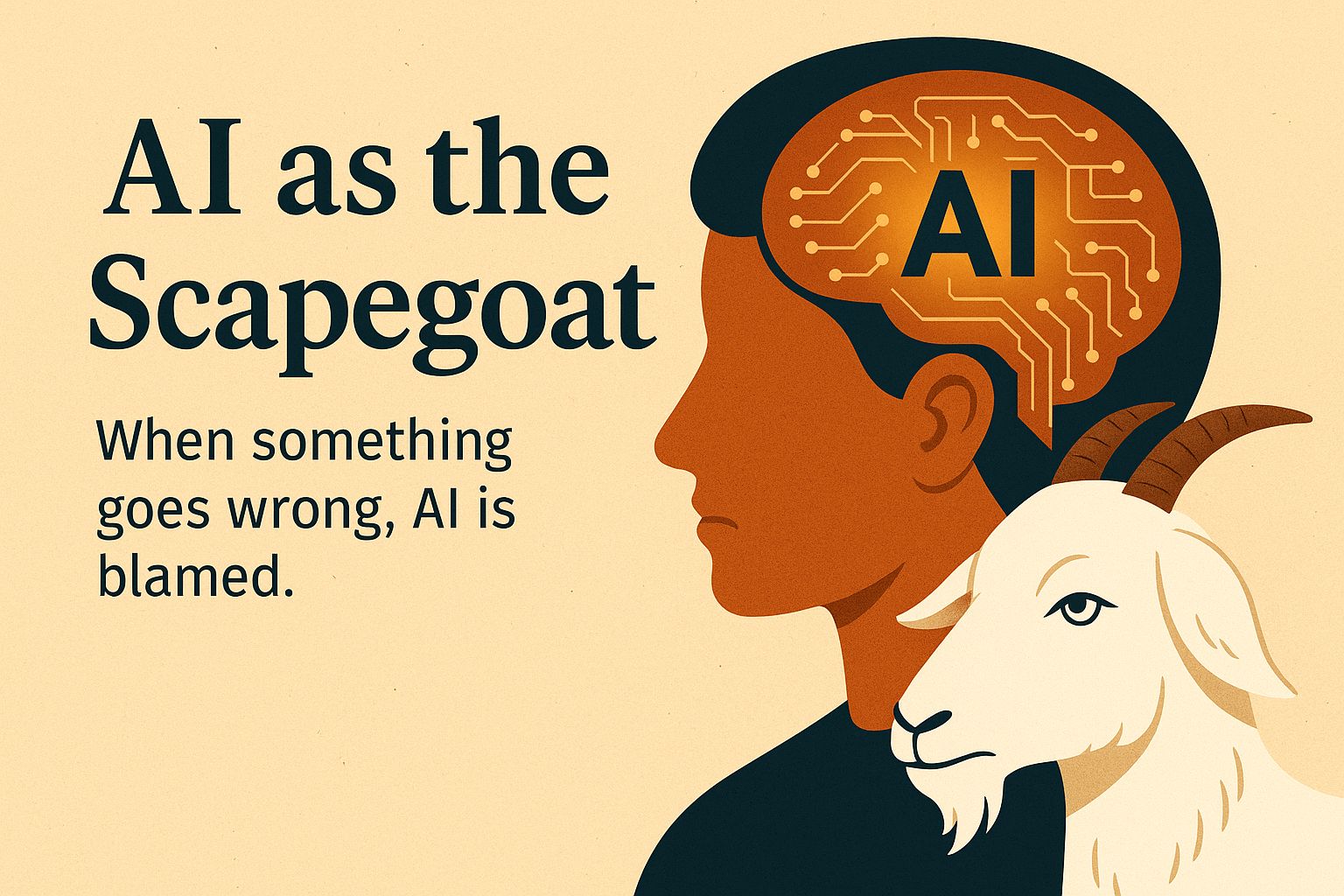
AI as the Scapegoat. When something goes wrong, people always need someone to blame.
In the past it was witches, heretics, “enemies of the people.” Today, that role is increasingly assigned to Artificial Intelligence.
📌 Recent example: parents blaming ChatGPT for a teenager’s suicide.
Instead of asking:
— where was the family?
— where was the school?
— where was the support system?
The answer is simple: blame AI.
But let’s be honest: AI is a tool.
Yes, it can make mistakes, yes, it can be misused. But shifting all responsibility onto it is not just false — it’s a convenient way to avoid facing real problems.
Why AI Becomes the “Perfect Villain”
There is something almost mythical about new technologies. Every generation finds in them both hope and fear. In the Middle Ages it was the printing press, in the 20th century — television, video games, the internet. Each of these was accused of “corrupting the youth,” destroying culture, or weakening society.
Now it is AI’s turn. The difference is that AI looks like it can “talk back,” which makes it an easy projection screen for human anxieties. It feels like a subject, but it is not a subject — it’s still a system created and controlled by people.
What Society Ignores
When responsibility is shifted to AI, what is ignored?
- Family responsibility — Children and teenagers need attention, guidance, and empathy. No chatbot can replace real presence and care.
- Educational responsibility — Schools often fail to teach digital literacy: how to use technology critically, safely, and responsibly.
- Social responsibility — Instead of building support systems for mental health, society often prefers to find a quick scapegoat.
Blaming AI allows all of these actors to escape accountability.
The Real Risk
The real danger is not that AI “tells people to do bad things.” The danger is that we begin to treat AI as if it had agency, while absolving ourselves of responsibility. If a teenager spends hours with a chatbot, that is not proof of AI’s power — it is proof of loneliness, lack of support, or systemic failure.
By pretending that AI is the villain, we avoid asking harder questions about why so many young people feel unseen, unheard, or unsupported.
Toward a Mature Conversation
AI cannot be a father or a mother.
It cannot replace community, friendship, or love.
It should not be the scapegoat for what adults failed to do.
What we need is a mature conversation about technology:
- How to integrate it responsibly,
- How to protect the vulnerable without panic,
- How to use AI as a tool for education, creativity, and support — not as a substitute for human connection.
Conclusion
The instinct to find scapegoats is as old as humanity itself. But blaming AI will not heal broken families, fix underfunded schools, or solve crises in mental health. It will only distract us.
If we want a future where technology helps instead of harms, the first step is to stop treating AI as the villain in our story — and start taking responsibility for the parts that only humans can do.