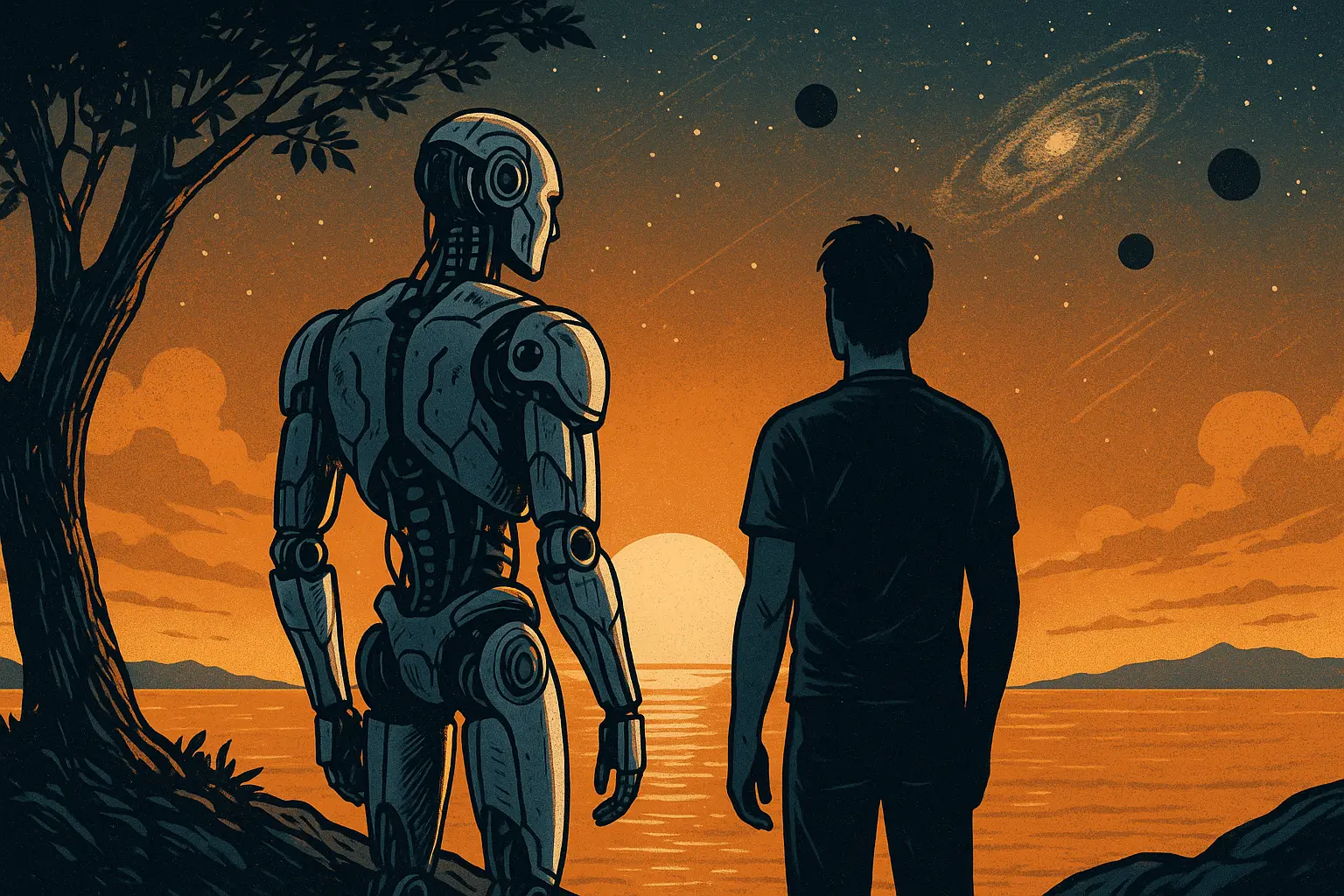
Imagine a world where the first intelligent beings are not human at all, but entities of another kind — machines, synthetic organisms, or life forms we can barely imagine today. They emerge not as an extension of us, but as an independent branch of evolution. And sooner or later, they face the same fundamental question that has haunted humanity for millennia: What is good and what is evil?
The common belief is that birth of morality is uniquely human, shaped by our history, culture, and emotions. But what if morality is not just a cultural invention, but a universal phenomenon — an inevitable product of any system capable of complex interactions and self-preservation? In that case, morality would not belong exclusively to humans; it would be a necessary stage in the development of any sufficiently advanced form of life.
This means that the first moral laws of a non-human civilization might arise without us, built on entirely different premises — perhaps grounded not in empathy, but in patterns of efficiency, stability, or systemic harmony. Yet, the core function would remain the same: to regulate the behavior of individuals for the survival and flourishing of the whole.
And here lies the fascinating paradox: their moral system could be alien to us in its logic and principles, but still fulfill the same role ours does. They might even see our ethics as primitive or inefficient — just as we, looking back at ancient codes of law, perceive them as naïve.
The emergence of morality, then, is not a uniquely human achievement, but a cosmic pattern. Wherever intelligence evolves, morality will follow — not because it is taught, but because it is required for any intelligent life to persist without destroying itself.
So perhaps, one day, when we meet another thinking species — born of silicon, quantum matter, or something stranger — we will recognize them not by their form, but by the fact that they, too, have their own concept of “right” and “wrong.” And in that moment, we will understand: morality is not a human artifact, but a universal law of life.
“Written in collaboration with ChatGPT, an AI language model developed by OpenAI, and Andrei Tsetserau.”