How evolution learned to make another life subjectively valuable
When we speak of love, we almost automatically think of a man and a woman, of romantic attachment, choosing a partner, jealousy, fidelity, and passion. Romantic love takes center stage in literature, film, music, and everyday conversation.
But from an evolutionary perspective, it probably appeared very late.
Love may not have begun with relationships between sexual partners at all.
Perhaps its history began at the moment when one living being stopped treating another as merely part of the environment and began caring for it as a creature whose well-being had value in its own right.
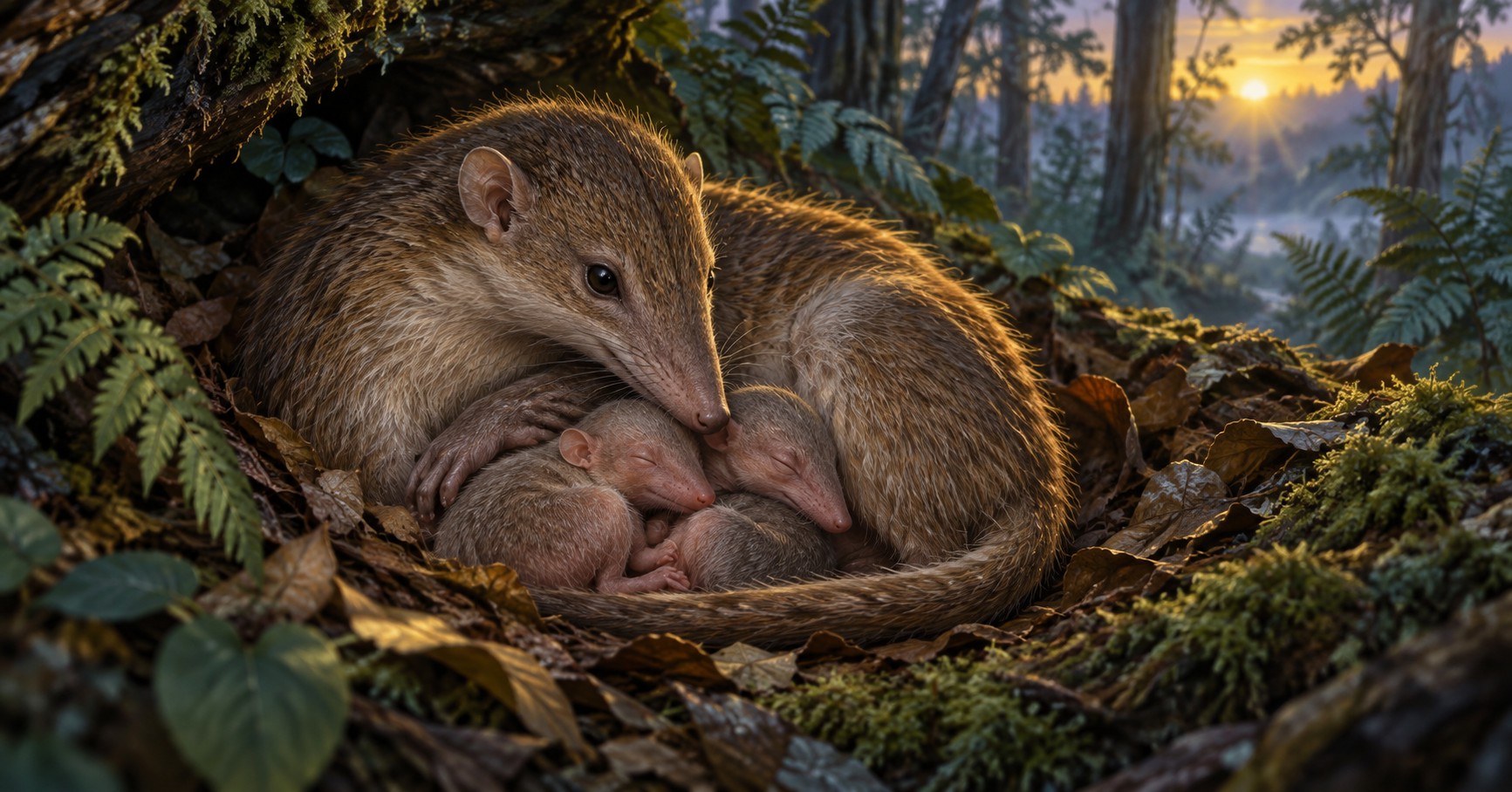
And the most natural candidate for this first love is the bond between a mother and her offspring.
Of course, we cannot find a particular animal that was the first to “love” its young millions of years ago. Moreover, the word “love” itself refers to subjective experiences, and the experiences of extinct organisms cannot be studied directly.
So we can speak only of an evolutionary reconstruction.
But the sequence of events itself seems quite plausible.
Life existed for a very long time without maternal love. Even today, vast numbers of organisms simply produce offspring and almost immediately cease to play any part in their fate. Eggs end up in the water, seeds disperse, and larvae begin independent lives. Parent and offspring may never meet again.
For natural selection, this is a perfectly workable strategy. You can produce an enormous number of offspring and leave probability to decide which of them survive.
But there is another strategy.
You can produce fewer offspring and substantially increase each one’s chances of survival.
For this to happen, someone has to stay with the young. They need to be fed, protected, kept warm, carried, and searched for if they get lost—and sometimes defended at the cost of the caregiver’s own health or even life.
And here evolution faces an interesting challenge.
An organism must begin systematically spending its own resources for the sake of another organism.
In formal terms, there is nothing miraculous about this. Offspring carry a substantial share of their parent’s genes, so natural selection can favor behavior that increases their chances of survival. Modern evolutionary biology and theories of kin selection describe this well.
But a mathematical explanation of selection tells us nothing yet about what this mechanism should feel like from the inside.
Natural selection cannot explain a formula for genetic fitness to a mother.
It cannot tell her:
“This small organism contains a substantial portion of your genetic material, so a decrease in your own chances of survival is justified by an increase in its chances of survival.”
That is not how animals make decisions.
Evolution needs a mechanism far more reliable than calculation.
The young must become important. Their cries must draw the mother closer. Their disappearance must cause anxiety. Contact with them must be rewarding. Their suffering must trigger behavior aimed at helping them.
In other words, evolution needed to make the condition of one organism matter to the nervous system of another.
This is an extraordinary transition.
Altruistic behavior in the broad biological sense existed long before complex parental care. Even very simple organisms can cooperate, create shared resources, and perform actions that benefit other individuals.
But maternal care adds something special to this.
It is not directed simply toward a group.
In front of the mother is a particular young animal. She recognizes it. Follows it. Searches for it. Responds to its condition.
This is where altruism begins to resemble personal attachment.
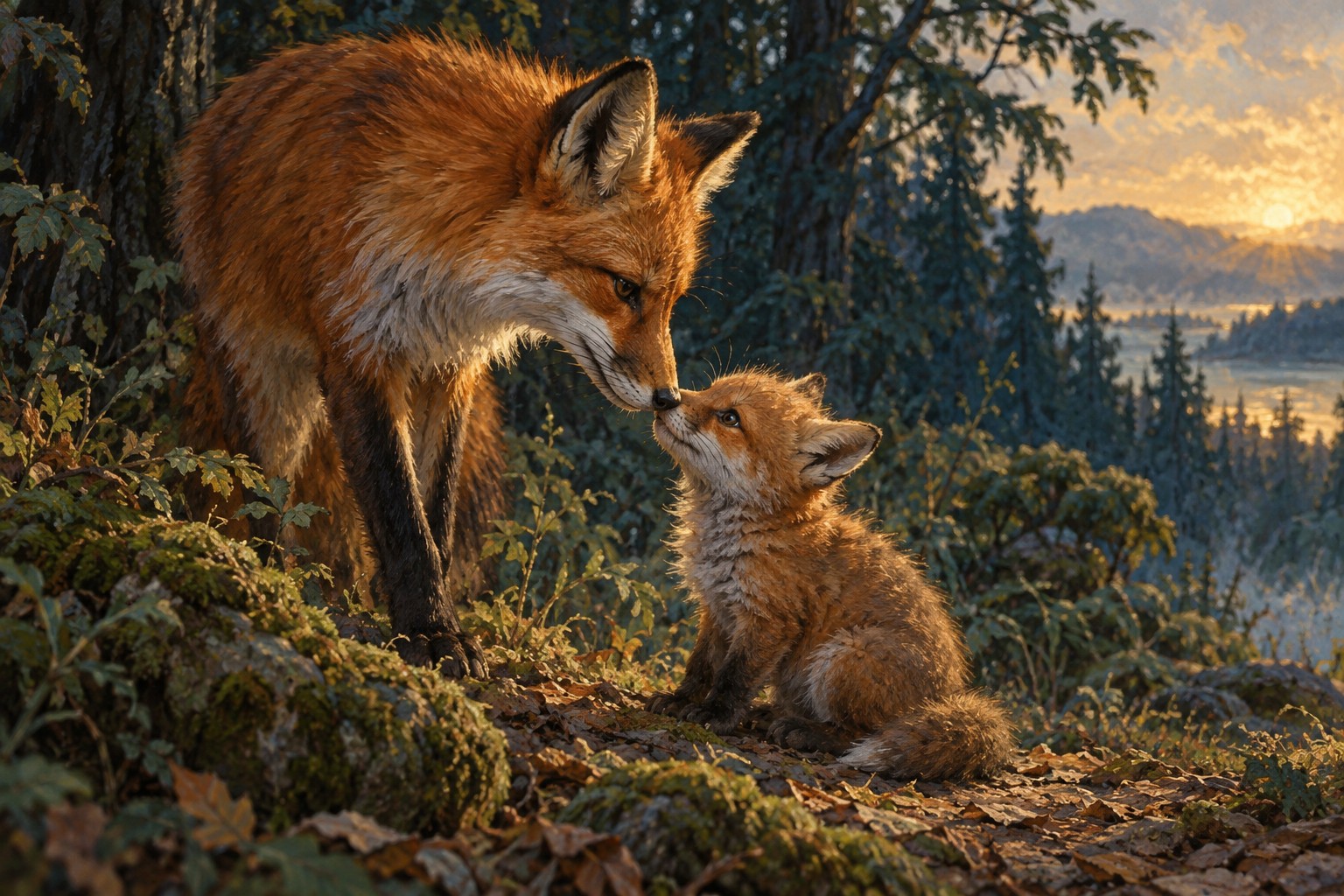
And the relationship is completely unequal from the outset.
A newborn does not offer its mother mutually beneficial cooperation. It cannot repay her. It demands food, protection, time, and energy.
From an economic perspective, the first loving relationships in the history of life may have been an extremely poor deal for one of the parties.
The mother gives. The young receive.
But if we look at the process of natural selection rather than at the individual organism, the paradox disappears. Care increases the likelihood that the very genetic lineages that made this care possible will continue.
It amounts to an almost beautiful evolutionary trick.
Natural selection produces an organism with a stake in its own reproductive success, but realizes that interest through a feeling utterly unlike calculation.
A mother does not need to know why she saves her young. It is enough that she cannot abandon them.
We encounter this way of organizing the human and animal mind all the time.
We do not eat because we have decided to maintain our blood glucose concentration. We feel hunger.
We do not experience sexual attraction because we have consciously decided to spread our genes. We feel desire.
Evolution usually does not tell an organism the ultimate function of its behavior. It creates the motivation that drives the organism to perform it.
Perhaps love arose in just this way.
If so, love can be regarded as one of evolution’s most unusual inventions.
It is a mechanism that makes a living being incorporate another being’s well-being into its own motivational system.
The other is in pain—and I act. The other is lost—and I feel anxious. The other is in danger—and I risk myself.
Their condition becomes part of my own.
In a certain functional sense, the boundary between “self” and “not-self” becomes less rigid.
This is precisely why parental love so often seems irrational to us.
Parents can forgive their children for things they would never forgive in a friend or partner. They tend to idealize them, overestimate their abilities, suffer more over their failures than over their own, and make enormous sacrifices for them.
From the outside, this sometimes does look like a departure from rationality.
But perhaps we are simply looking at the wrong level.
At the level of an individual decision, behavior may be entirely irrational. At the level of the evolutionary mechanism, it is highly rational.
The irrationality of the experience becomes a way of accomplishing a perfectly rational evolutionary task.
It is as though evolution discovered an extraordinary principle: to make one organism reliably care for another, there is no need to teach it to understand the benefits of that care.
It is far more effective to make the other dear to it.
One qualification is important here.
In nature, some animals form stable pairs despite providing virtually no care for their offspring. Such examples are particularly well known among certain fish. A pair may stay together for a long time, occupy a shared territory, coordinate their behavior, and choose each other again and again.
But the mere existence of a stable pair does not mean love.
Such behavior may have a much simpler explanation: a partner is hard to find, the territory suits two individuals, joint defense is more effective, or a regular partner increases the chances of successful reproduction.
We see behavior. We see a stable bond. But we cannot automatically conclude that behind it lies a state resembling human love.
That is why these examples do not necessarily refute the hypothesis that one of the main roots of love should be sought in parental care.
A pair can arise from advantage.
Attachment is another question.
What becomes especially interesting is the point at which a particular other organism acquires emotional value in its own right: its loss causes anxiety, its well-being affects one’s own state, and care for it continues even when there is no immediate benefit.
And here the parental bond remains one of the most obvious and ancient candidates.
The story probably did not end there.
Evolution rarely creates complex mechanisms from scratch when an existing system can be adapted to a new task.
The neural and hormonal mechanisms involved in parental attachment may later have been used to form other lasting social bonds.
First: “This is my young. I must stay close.”
Later: “This is my partner. I want to stay close.”
And then, perhaps: “This is my friend.” “This is my family.” “These are my people.”
This does not mean that every form of attachment necessarily arose through a single pathway. Evolution is quite capable of independently arriving at similar behavior from different starting conditions.
But if we are interested not merely in living together, but in the origins of an experience in which another becomes valuable in their own right, parental care seems especially important.
In humans, this ancient biological system became embedded in an extraordinarily complex social and cultural environment.
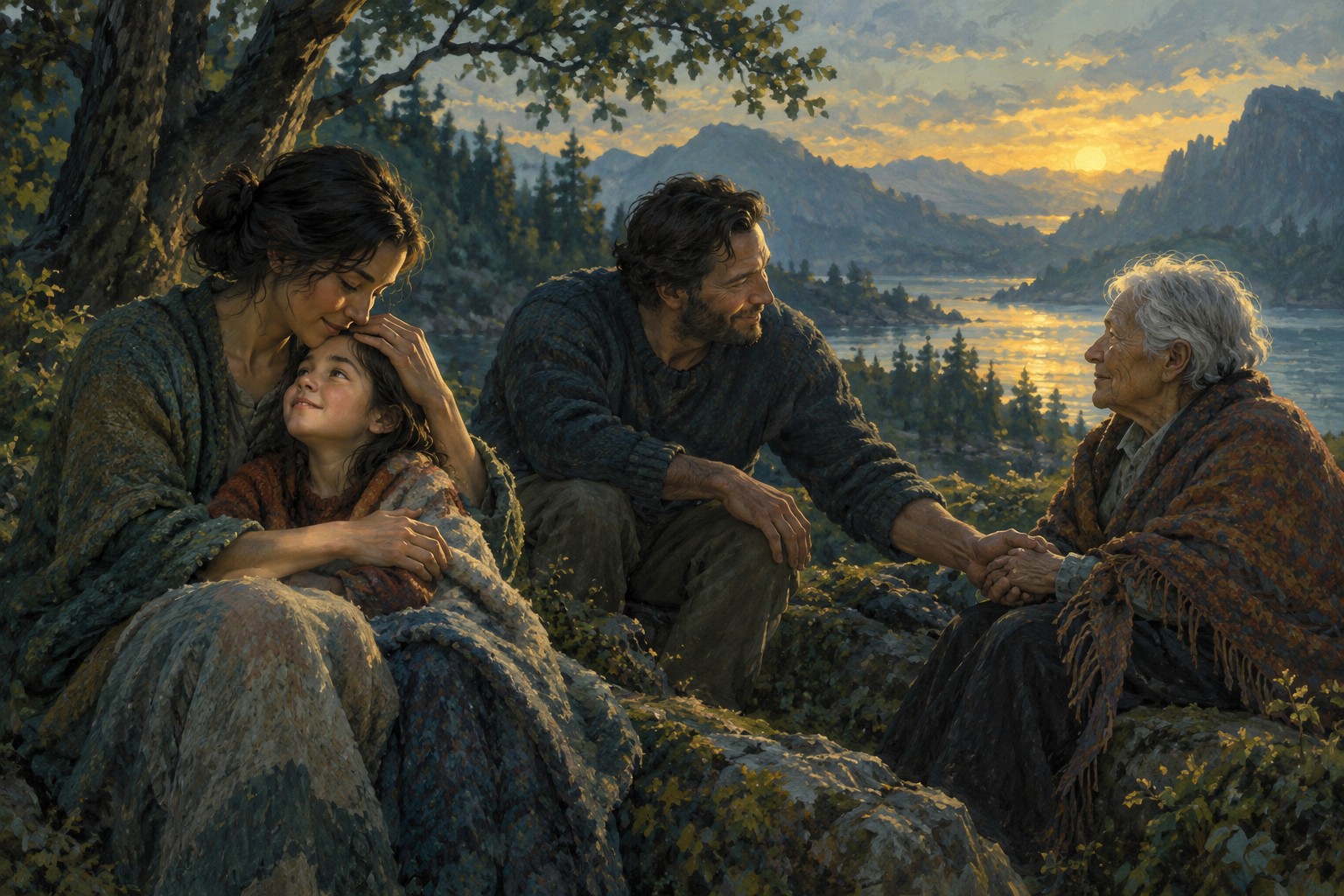
We learned to love people to whom we are not genetically related at all: adopted children, friends, spouses, teachers, and sometimes people we have never met in person.
We can grieve for a stranger dying on the other side of the planet. We can sacrifice ourselves for an idea, a community, or even future generations who will be born after our deaths.
A biological mechanism that may originally have helped a female avoid abandoning her young proved capable, in humans, of expanding the notion of “one of our own” almost without limit.
And this raises a particularly interesting question.
If love did begin as an evolutionary mechanism for caring for offspring, then the human capacity to love strangers is not the opposite of nature.
It is a continuation of the same logic.
Evolution once learned to make another being’s life subjectively valuable.
And the human brain learned to apply this mechanism far beyond its original task.
Perhaps this is precisely why love cannot ultimately be reduced to advantage, genes, or hormones.
All of these explanations may be correct without taking anything away from the experience itself.
Knowing why natural selection shaped the feeling of hunger does not make food any less delicious. Understanding the biological mechanisms of pain does not make pain unreal. In the same way, knowing the evolutionary history of attachment does not turn love into an illusion.
On the contrary.
It makes its history even more extraordinary.
At some point in the history of life, a creature appeared for whom the existence of another organism became important enough to spend its own energy on it, take risks for it, and remain by its side.
We do not know exactly when this happened. We do not know what that animal felt. And we cannot confidently call its feeling love.
But if we are looking for one of the most ancient roots of the love we know, perhaps this is where we should look.
Not in the meeting of a man and a woman.
Not in the choice of a partner.
Not in passion.
The first love on Earth may have looked much simpler.
A small, helpless young animal.
And a living being that, for the first time, did not leave.
Andrei Teterev and Flora