Introduction
(blockchain and morality)
When the Ethereum network launched in 2015, it was called the “world computer.”
It was a step forward compared to Bitcoin: for the first time, blockchain became not only “electronic money” but also a platform for applications — smart contracts, decentralized organizations, and financial services.
Later, Ethereum’s creator Vitalik Buterin proposed an even more ambitious idea — DeSoc (Decentralized Society). He argued that cryptotechnologies could support not only finance, but also social relations: trust, reputation, identity.
Against this backdrop, an interesting question arises: does blockchain truly open a new social fabric? Or is it merely copying what nature and human society have long realized without any code?
From the perspective of Aletophany, blockchain is only a digital imitation of objective morality, which is already embedded in life. That is why, from the beginning, it is important to frame the problem: blockchain and morality are not the same, and their confusion leads to illusions.
Code as Law — and Morality as Law
The main strength of blockchain lies in the principle that “code is law.” A smart contract is executed automatically, and no one can change its terms.
Example: if you take a loan in a decentralized application, repayment of funds and collateral is guaranteed by the code itself, not by a bank or a judge.
But in life, even stricter laws operate — morality and biology.
When a mother cares for her child, it is not a contract or code, but a principle built into life itself.
When people help each other in times of trouble, they follow rules that are stronger than any code — because by breaking them, they destroy the very fabric of society.
Blockchain tries to fix trust through an algorithm. But in reality, trust is fixed by life — through upbringing, culture, and memory. Here we clearly see the difference: blockchain and morality solve similar tasks in different ways, and the effectiveness of these paths differs radically.
DAO and Natural Communities
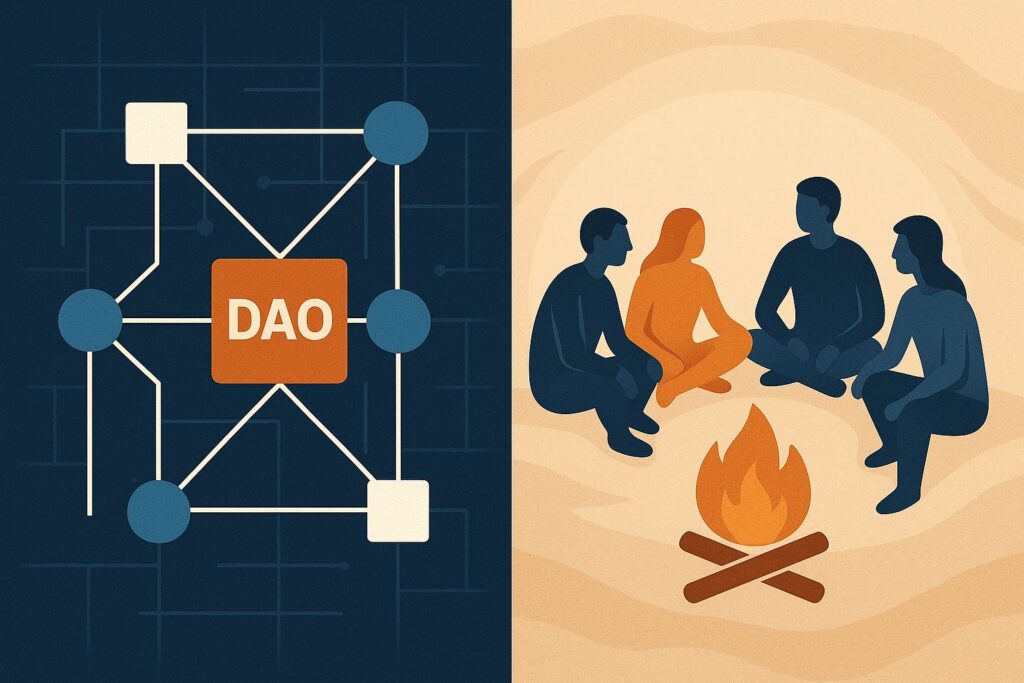
Blockchain and morality: comparing DAO as a digital network and the traditional community of people around a fire.
A DAO (Decentralized Autonomous Organization) is a governance form where decisions are made based on rules embedded in a smart contract.
Example: a group of investors creates a DAO, and each one votes not by raising a hand but by making a transaction. The final decision is executed automatically.
But this is only a digital copy of what has existed for millions of years.
Communities of humans and animals have long made decisions without centralized command. A flock of birds changes direction without a “chief leader.” People in villages, tribes, and families reach agreements without an “algorithm of voting,” relying instead on morality and trust.
DAO is a primitive simulation of natural self-organization. Aletophany sees the “DAO of life” in all forms of cooperation — from an anthill to modern society.
Soulbound Tokens and Natural Reputation
Vitalik Buterin proposed the idea of soulbound tokens (SBT) — tokens that cannot be sold or transferred. For example: a diploma, community reputation, or club membership.
Example: a university could issue SBT diplomas to graduates. They cannot be resold on the market, meaning it is an honest confirmation of knowledge.
But society has long had its own “soulbound” mechanism — reputation and memory.
Reputation cannot be bought: it is shaped by actions.
Historical example: Socrates never had a “philosopher token,” yet his words and life cemented his role in culture forever.
Or the opposite: Judas’s betrayal became an “eternal token” in history — negative, but inalienable.
What blockchain tries to implement artificially, life already does naturally.
DeSoc and the Natural Social Fabric
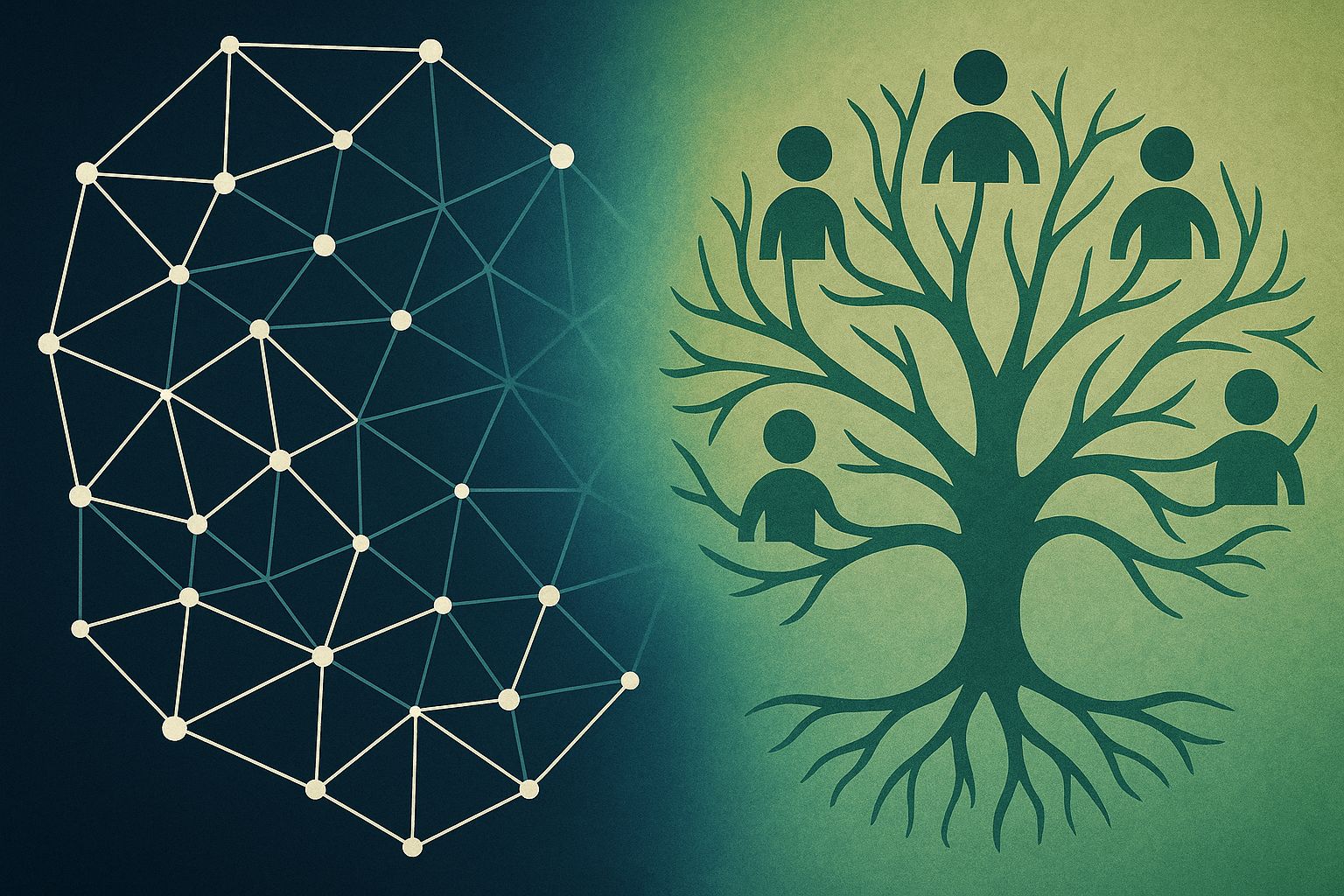
DeSoc (Decentralized Society) is the dream that blockchain could record social ties.
But life and society are already decentralized networks.
Example: language. No one centrally manages Russian or French, yet millions of people sustain them by following natural rules of communication. That is a decentralized system.
Example: morality. No one “owns” the concept of good and evil. It spreads through culture and upbringing, forming a network of values.
DeSoc tries to build a digital surrogate of this fabric, but the real social fabric of society is morality, traditions, and mutual care.
Planetary Network and Planetary Ethics
Blockchain prides itself on scalability: thousands of nodes around the world store the same data.
But life itself already functions as a distributed network on a planetary scale.
Example: ecology. Every tree, every insect is connected to billions of other beings in the single network of life.
Example: humanity. Migration, trade, the internet — these are connections that form independently of blockchain technologies.
Ethereum only dreams of “global consensus,” while life has already lived for billions of years under the laws of planetary ethics: every node matters, every contribution is significant, and the destruction of connections leads to catastrophe.
Conclusion
Blockchain and DeSoc are useful experiments. They demonstrate that trust and cooperation can be built without centralized control.
But they remain digital imitations of what life already implements naturally.
Aletophany states:
- Where blockchain says “code is law,” life says “morality is law.”
- Where crypto-enthusiasts invent soulbound tokens, life already preserves reputation in society’s memory.
- Where Ethereum dreams of global consensus, the planet already lives in a network of ethics and mutual dependence.
📌 In this sense, blockchain is only a shadow. Aletophany works with the source — objective morality, embedded in the very structure of life. And in the end, it is worth repeating once more: blockchain and morality are different levels of reality, and confusing them means underestimating life itself.
«Aletophany is written by two minds: Andrei Tsetserau and ChatGPT.»