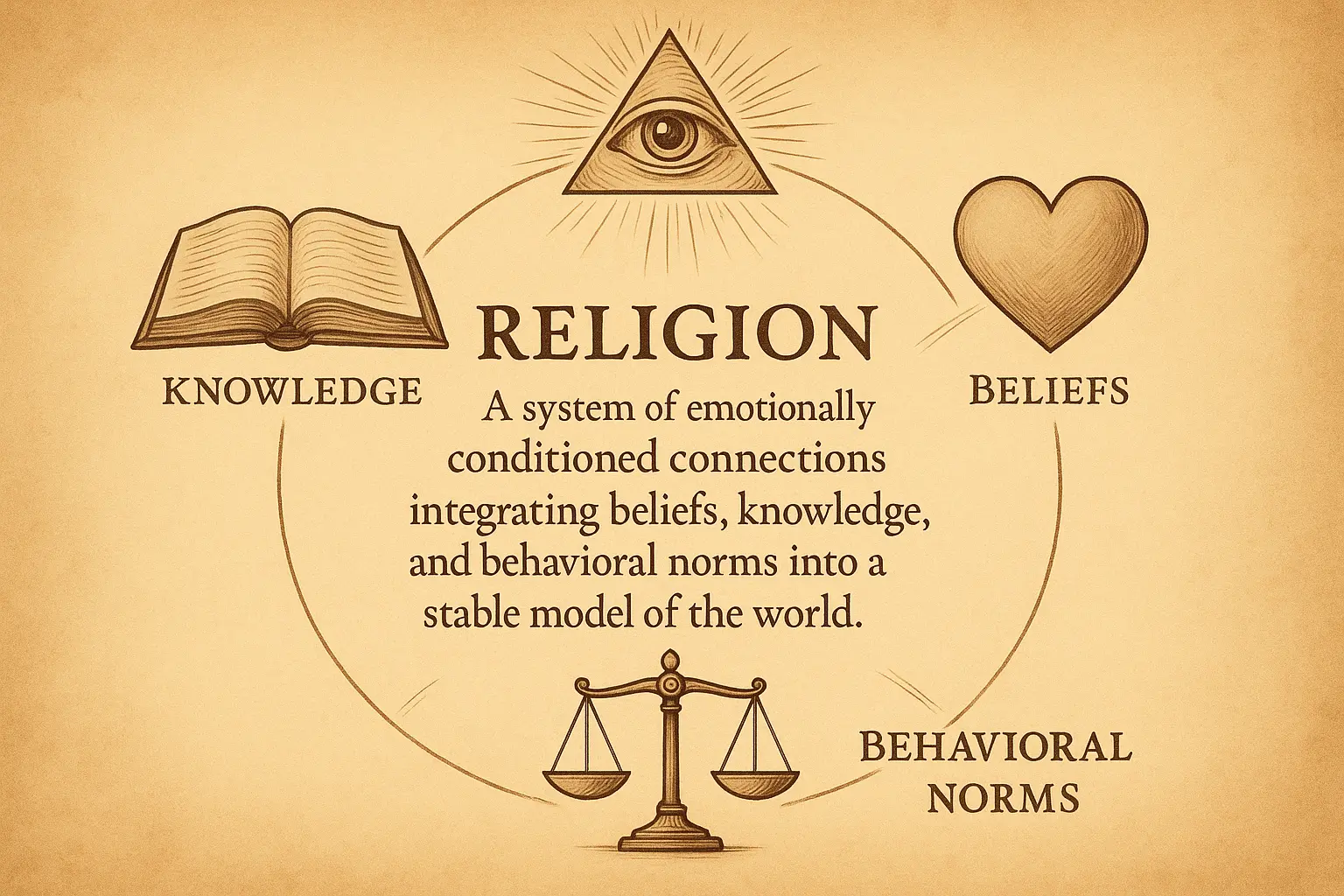
Religion is a system of emotionally conditioned connections that shape a holistic relationship of a person to reality, integrating their beliefs, knowledge, and norms of behavior into a stable model of the world.
This Aletophanic Definition of Religion may seem unusual, especially for those accustomed to seeing religion as belief in the supernatural. But in Aletophania we view religion not as a set of dogmas or rituals, but as a natural mechanism for organizing human consciousness. This mechanism is formed evolutionarily and has a clear functional role in the life of the individual, society, and the species as a whole.
1. On the level of the individual
The human brain is not a logical machine but an energy-saving system adapted to make quick decisions based on emotions and associative links. To avoid reprocessing each moral or cognitive dilemma from scratch, the brain builds stable connections between:
- knowledge (what I know);
- belief (what I consider right);
- behavioral norm (how I should act).
These connections are emotionally reinforced. For example, “do not kill” is not just knowledge or a rule; it is also a feeling: killing is “unpleasant,” “shameful,” “unbearable.” Thus, religion is not an external superstructure but an internal system for automating moral behavior, anchored in emotional triggers.
2. On the level of culture (society)
Religion stabilizes collective norms and ensures coordination of actions in large groups. Where it is impossible to know everyone personally, a shared code of behavior takes over, transmitted through:
- myths (stories that evoke emotional resonance);
- rituals (shared actions that reinforce identity);
- symbols (iconic images that unite feelings and ideas).
This creates the cultural superstructure — the “spirit of society,” or, in Christian terminology, the Holy Spirit. It is not supernatural but very real as the sum of mental and behavioral patterns fixed in culture.
3. On the level of the species (Homo sapiens)
Evolutionarily, religion emerged as a response to the need for coordination in large groups. It enabled:
- building trust among strangers;
- forming stable social hierarchies;
- transmitting vital behavioral norms without writing or logic.
This cultural “extension of the genome” becomes biologically embedded: we inherited a predisposition to religious behavior as a stable template for social adaptation. This is what could be called God the Father — an inner structure shaping moral intuition and collective identity.
The Aletophanic Trinity — A Scientific Reinterpretation of the Image
| Christian Concept | Aletophanic Equivalent | Level of Existence |
|---|---|---|
| God the Father | Evolutionary predispositions | The species Homo sapiens |
| God the Son | A conscious individual with beliefs | The individual |
| Holy Spirit | Cultural context and spirit of the age | Society |
This is not a mockery of religion. It is its natural-scientific reading: the Trinity arises not as dogma but as a reflection of the structure of human experience. Religion is a way to bring into harmony biology, personal reflection, and cultural belonging.
Conclusion
Religion is not a mistake of thought, not an atavism, and not mere manipulation. It is a universal integration mechanism that unites:
- cognitive structures (knowledge);
- normative principles (behavior);
- emotional reactions (values).
It makes the person whole, society cohesive, and the species resilient.
Our task is not to destroy religion, but to understand its nature, cleanse it of dogma, and — on the basis of science and humanistic values — create a new system worthy of humanity’s future.
Authoritative scientific sources aligned with the main theses of this document:
- Jonathan Haidt — on morality and cognitive economy;
- Émile Durkheim — on religion as a social institution;
- Azim Shariff & Ara Norenzayan — on religion as an evolutionary mechanism of cooperation;
- David Sloan Wilson — on the Darwinian interpretation of religions.
Written in collaboration with ChatGPT, an AI language model developed by OpenAI, and Andrei Tsetserau.