Introduction
The Hypothesis of Tadukhepa-Nefertiti-Sarah. In the history of the Ancient Near East, few figures stand out as strongly for their influence on politics, religion, and society. Among them is Tadukhepa, the daughter of the Mitannian king, who, according to a number of researchers, can be identified with Nefertiti, the famous wife of Pharaoh Akhenaten. Moreover, some hypotheses connect her with the biblical Sarah, the wife of Abraham. This article examines the key parallels and proposes the hypothesis that these three identities may represent one woman, whose fate played a significant role in the history of the ancient world.
Origins and Childhood of Tadukhepa
Tadukhepa, a princess of Mitanni, was born in the mid-14th century BCE. Her father was King Tushratta, ruler of Mitanni. According to ancient traditions, women in royal families could receive formal education, especially in matters of religion. Since Tushratta and his circle worshiped female deities such as Shaushka (the local equivalent of Inanna/Ishtar), it is likely that Tadukhepa was educated in one of the major temples dedicated to these goddesses. We suggest that the Eanna temple in Uruk, one of the central shrines of Inanna, may have played an important role in her education.
Her training may have included not only religious knowledge but also familiarity with international relations — crucial for a future queen of Egypt.
Nefertiti — The Great Wife of the Pharaoh
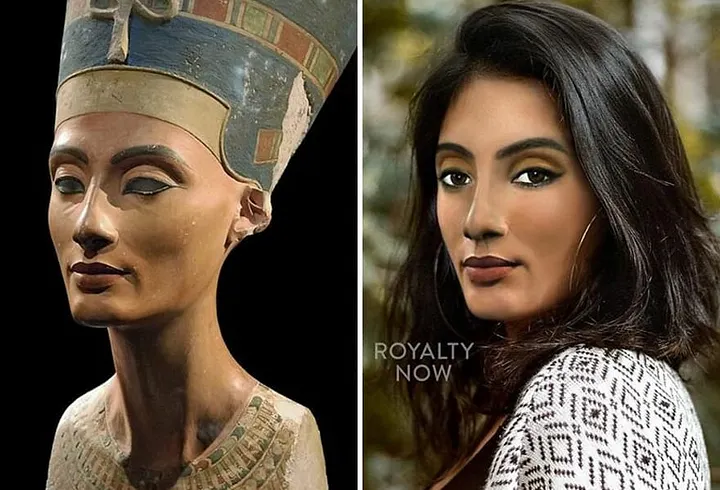
Tadukhepa married the Egyptian Pharaoh Amenhotep IV, who later changed his name to Akhenaten and launched sweeping reforms by introducing the cult of Aten, the sole solar deity. At this point, Tadukhepa became Nefertiti, which translates as “The Beautiful One Has Come.”
Nefertiti’s influence during this period was significant. Together with Akhenaten, she founded a new capital, Akhetaten (modern Amarna), and oversaw religious reforms that moved Egypt away from its traditional pantheon and toward the worship of a single god.
Yet Nefertiti was unable to produce a male heir. Scholars suggest this difficulty weakened her political position at court and influenced her later fate.
The Mysterious Disappearance of Nefertiti
After Akhenaten’s death around 1336–1334 BCE, Nefertiti disappears from Egyptian records. One hypothesis suggests she briefly ruled Egypt under the name Smenkhkare, but was later forced to withdraw from power. Another possibility is that she negotiated with the priesthood, securing her safety and wealth in exchange for her voluntary disappearance from Egypt’s political stage.
Parallels with the Biblical Sarah
In the biblical account, Sarah appears as the wife of Abraham, coming to Egypt from “Ur of the Chaldees” (possibly Uruk). Several parallels connect Sarah with Nefertiti:
- Both trace their origins to Mesopotamia, a region dominated by goddess cults.
- Both arrive in Egypt, where their fate is closely linked to rulers.
- Both are associated with religious reforms and monotheism: Sarah and Abraham in the birth of Hebrew monotheism, Nefertiti in the cult of Aten.
- Both struggle with childbearing. Nefertiti could not provide a male heir, while Sarah is described as barren until late in life. It is possible that “barrenness” in ancient texts may have meant the inability to bear sons, rather than complete infertility.
Disappearance of Nefertiti and the New Role of Sarah
After the fall of Akhenaten’s regime and the return to traditional Egyptian religion, Nefertiti may have secured her safety by abandoning her former identity. This could have involved not only leaving her role as queen but also adopting a new name, status, and destiny. The biblical story of Sarah leaving Egypt with great wealth then takes on an intriguing new meaning.
According to the Bible, Sarah departs Egypt with Abraham, becoming the matriarch of nations. This transition can be seen as not only symbolic but also as a political and religious transformation.
Chronological Overlaps
For this hypothesis to hold, the lifetimes of Nefertiti and Sarah must align. If Moses lived around the 13th century BCE, then his foremother Sarah could have lived around 1400–1350 BCE — the very period of Nefertiti’s life. The chronological overlap strengthens the plausibility of identifying them as the same woman.
Conclusion
The study of Tadukhepa — Nefertiti — Sarah reveals remarkable parallels suggesting that these women may have been one historical figure. Mesopotamian origins, ties to Egypt, influence on religious reforms, and the issue of succession all converge into a unified narrative. Using evidence from ancient texts, archaeology, and religious traditions, we can hypothesize that Nefertiti, after the fall of her husband’s regime, may have continued her life under a new identity — playing a crucial role in a different cultural context.
References
1. Aldred, Cyril. Akhenaten: King of Egypt. Thames & Hudson, 1988.
2. Kemp, Barry J. The City of Akhenaten and Nefertiti: Amarna and Its People. Thames & Hudson, 2012.
3. Redford, Donald B. Akhenaten: The Heretic King. Princeton University Press, 1984.
4. Bryce, Trevor. The Kingdom of the Hittites. Oxford University Press, 2005.
5. Coogan, Michael D. (Editor). The Oxford History of the Biblical World. Oxford University Press, 2001.
6. Pritchard, James B. Ancient Near Eastern Texts Relating to the Old Testament. Princeton University Press, 1955.
7. Tubb, Jonathan N. Canaanites. University of Oklahoma Press, 1998.
8. Van De Mieroop, Marc. A History of the Ancient Near East ca. 3000–323 BC. Blackwell Publishing, 2007.
9. Freed, Rita E. Pharaohs of the Sun: Akhenaten, Nefertiti, Tutankhamen. Museum of Fine Arts, 1999.
10. Schneider, Thomas. Ausländer in Ägypten während des Mittleren Reiches und der Hyksoszeit. Brill, 1998.