Introduction. Two accounts with different foundations
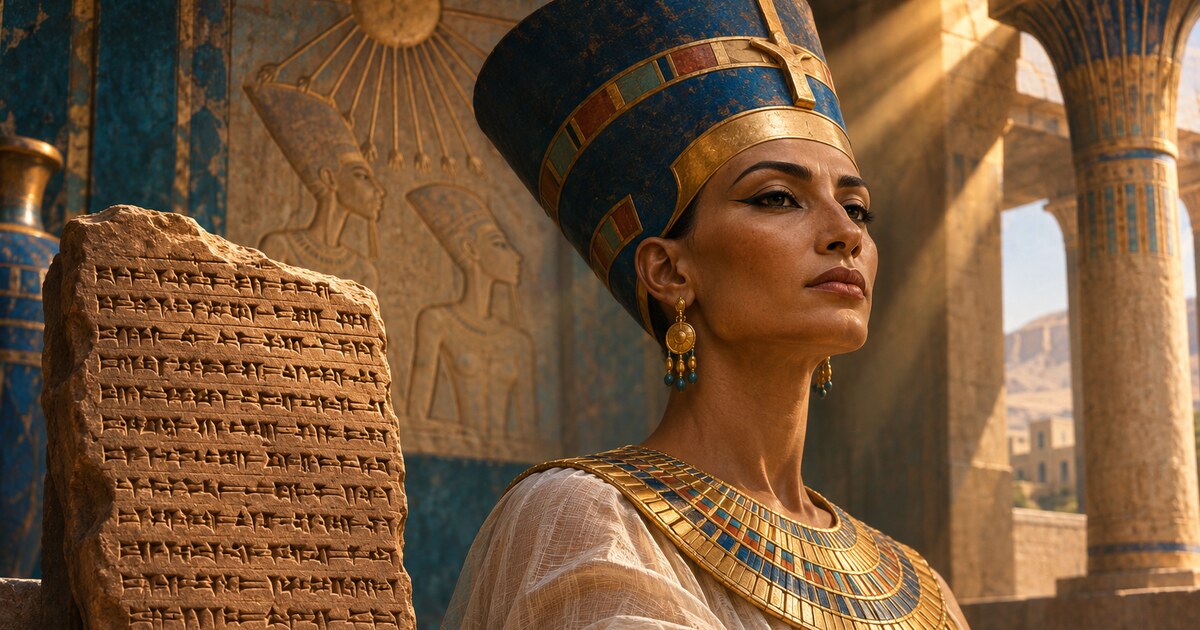
Who was Nefertiti before she became Akhenaten’s Great Royal Wife? For all her fame, Egyptology still has no certain answer. One widely held view places her in the Egyptian elite and suggests she may have been the daughter of Ay, a prominent official who later became pharaoh. Another identifies her as Tadukhepa, daughter of King Tushratta of Mitanni, who was sent to marry an Egyptian pharaoh.
These accounts are often presented as parallel attempts to explain the same mystery. The sources behind them, however, differ in an important respect. Tadukhepa is a documented historical figure. Contemporary diplomatic letters establish who her father was, where she came from, the circumstances of her dynastic marriage, and her position in the Egyptian royal family. No inscription directly names Ay as Nefertiti’s father. The proposed relationship is reconstructed from court titles, ties among officials, and assumptions about otherwise unknown relatives.
The main evidence for the Egyptian account also admits a political explanation based on alliances Nefertiti herself may have formed. That difference in the evidence is our starting point. The identification of Tadukhepa with Nefertiti remains open, but why should descent from an otherwise unknown wife of Ay take precedence over identification with a documented wife of the same pharaoh? The surviving records let us examine both proposals.
1. Tadukhepa’s documented origins
In the fourteenth century BCE, Egypt maintained close diplomatic relations with Mitanni, a powerful kingdom in Upper Mesopotamia and surrounding regions. Dynastic marriages reinforced the alliance between the royal houses. Before Tadukhepa arrived, the Mitannian princess Gilukhepa had already married Amenhotep III. King Tushratta later negotiated the marriage of his daughter Tadukhepa to the same pharaoh.
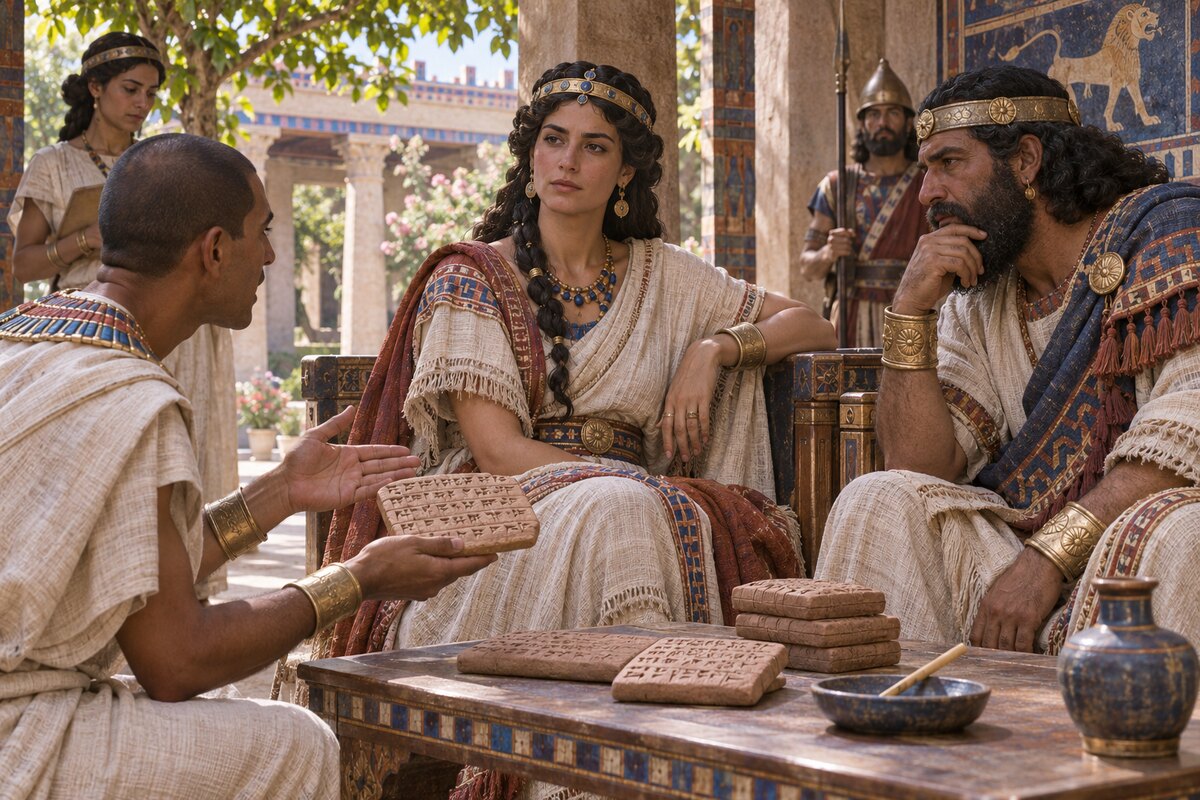
The negotiations survive in the Amarna archive, a collection of cuneiform diplomatic correspondence discovered at ancient Akhetaten. In EA 19 and EA 20, Tushratta discusses sending his daughter and the terms of the dynastic agreement. The letters name Egyptian envoys, including Mane, who met the princess. Tushratta paid particular attention to the position his daughter would hold in Egypt, and the diplomatic language underscores the rank envisaged for Pharaoh’s bride.
The letters establish who Tadukhepa’s father was, which royal house she belonged to, why she was sent to Egypt, and whom she was originally to marry. Her biography before she appears at Akhenaten’s court rests on primary documents that exist independently of the debate about Nefertiti. The most important letter for our question concerns what happened next.
2. ‘Tadu-Heba, my daughter, your wife’
After Amenhotep III died, his son Amenhotep IV, the future Akhenaten, succeeded him. What became of the Mitannian princess originally intended for the previous pharaoh? Her own father’s letters provide an answer. In EA 27 and EA 28 Tushratta addresses the new ruler. At the start of EA 28, he calls Amenhotep IV his son-in-law and himself the king’s father-in-law. Then, in his greetings to members of the royal family, he names Tadukhepa. William Moran’s translation is explicit:
Tadu-Heba, my daughter, your wife.
The letter identifies her as the new ruler’s wife. We therefore know the name and family history of a woman in Akhenaten’s royal household. The letters give her no title of Great Royal Wife, so her exact place among his wives remains open. They do establish that Tadukhepa was known as Akhenaten’s wife.
After this exchange, the princess’s life can no longer be traced under her Mitannian name in the sources available to us. Why does a woman of such rank, whose marriage sealed an international agreement, disappear from the surviving record? A change in her position and name is one possible explanation.
3. Nefertiti, a queen of unknown origins
The early life of Nefertiti is scarcely documented. Her images and inscriptions date from the time when she was already Amenhotep IV’s wife. They show her in court and religious scenes and tell us her titles, the names of her daughters, and her prominent place in Akhenaten’s religious system.
We have no inscription that names her parents, no record of her birth or childhood, and no reliable account of the circumstances of her marriage. The Egyptian Museum in Berlin, which houses her famous bust, likewise stresses how little is known about her origins and how much of her early biography remains conjectural.
One record begins with Tadukhepa, daughter of Tushratta, and takes her as far as her marriage to Akhenaten. The other begins with Nefertiti, wife of the same ruler, whose activities at court are well documented and whose earlier life is unknown. Could these records preserve two parts of one woman’s life? Connecting them requires a change of name and Tadukhepa’s elevation to Great Royal Wife. Egyptian court practice offers a way to assess that possibility.
4. Could Tadukhepa have taken the name Nefertiti?
Nefertiti’s name is usually translated as ‘The Beautiful One Has Come’. Egyptian names could carry religious and symbolic meanings, so the phrase alone cannot establish a foreign origin. An Egyptian name for a foreign princess, however, fits a known court practice. A Hittite princess who came to Egypt to marry Ramesses II took the Egyptian name Maathorneferure and became Great Royal Wife. The example comes from a later dynasty, and it establishes what was possible at court.
For Tadukhepa, such a change could have held political significance. Her first marriage was to Amenhotep III. After his death, she was described as the new pharaoh’s wife and would have had to find her place in a changed political order. A new Egyptian name could have marked her incorporation into the royal household and her new religious and political role.
If Tadukhepa took the name Nefertiti, the disappearance of her Mitannian name can be explained while she remains part of the royal family. An existing wife would simply have become known under a different name. A document recording the change has yet to be found, and that remains the hypothesis’s central missing link.
5. Where did Ay’s presumed daughter come from?
Ay was a prominent courtier under Akhenaten and later became pharaoh. His wife Tey held the title of Nefertiti’s nurse or caregiver. Ay himself was called ‘God’s Father’, a title some scholars interpret here as a possible reference to the king’s father-in-law. This is the basis for the suggestion that Nefertiti was Ay’s daughter.
No known inscription calls Nefertiti the daughter of Ay, and her parents’ names are unknown. Because Tey is called the queen’s nurse and no record identifies her as the queen’s mother, the reconstruction often introduces an earlier wife of Ay, who is presumed to have borne Nefertiti. The argument proceeds through several steps:
- Ay’s title ‘God’s Father’ is interpreted as indicating a relationship to Akhenaten through marriage.
- Nefertiti is assumed to have been the person who linked the two men.
- Ay is then identified as her biological father.
- An unknown earlier wife of Ay is proposed to account for Tey’s position.
This reasoning appears in scholarship. The Routledge Companion to Women and Monarchy in the Ancient Mediterranean World, for example, presents descent from Ay as a possibility based on the interpretation of titles and explicitly describes his proposed first wife as unknown.
Such inferences are a normal part of historical inquiry. The difficulty comes when the reconstruction begins to read like an established account of Nefertiti’s ancestry. No independent source establishes that Ay had a daughter who became Akhenaten’s Great Royal Wife. The proposed daughter enters the reconstruction through the attempt to place Nefertiti in Ay’s family. Ay’s prominence and Tey’s closeness to the queen are documented. The claim that Ay’s paternity explains their closeness is an inference from those facts.
6. What direct evidence of parentage looks like
There are cases where the parentage of an Egyptian royal wife can be established from independent monuments and inscriptions. Queen Tiye, wife of Amenhotep III and mother of Akhenaten, offers one example. Her parents, Yuya and Tuya, are known by name and title and from their burial monuments. Their tomb, KV46, was discovered in the Valley of the Kings. The evidence establishes the family relationship and the parents’ positions directly.
Few queens left such a rich record. The example illustrates the difference between a documented genealogy and a proposed one. Tadukhepa’s father is named in diplomatic letters, and Queen Tiye’s parents are known from monuments. The proposed link to Ay has no corresponding genealogical record. The statement ‘Nefertiti was Ay’s daughter’ therefore rests on a different kind of evidence from ‘Tadukhepa was Tushratta’s daughter’. The remaining question is which biography, if either, was Nefertiti’s.
7. Tey as nurse, caregiver, or political ally
A central piece of evidence for Egyptian origins is the title held by Tey, Ay’s wife. Amarna inscriptions call her Nefertiti’s nurse or caregiver. This has sometimes been taken to imply that Nefertiti must have been born and raised in Egypt. The title alone gives neither her birthplace nor her age when the relationship with Tey began.
Catharine Roehrig examined the titles of royal nurses and tutors of the Eighteenth Dynasty and their significance at court. For several women, images and specific epithets support a literal reading. Baky, for instance, is depicted nursing the future Amenhotep II. No equally unambiguous depiction of Tey nursing Nefertiti survives.
There is also a long history of scholarship considering honorary or symbolic uses of such titles. Philippe Virey proposed that the title might be bestowed as a matter of court etiquette. Gaston Maspero suggested a rite involving symbolic nursing. Roehrig showed why literal breastfeeding is well supported for many royal nurses, so a symbolic reading cannot simply be assumed for Tey. In her particular case, however, neither the wording nor the surviving images establish that she nursed Nefertiti as an infant.
When, then, did the two women become close, and what role did Tey play? If Nefertiti was Tadukhepa, who arrived from Mitanni as a royal bride, Tey could have become her mentor, patron, or trusted courtier after the princess came to Egypt. An Egyptian caregiver is compatible with a foreign-born queen on that reading. Their relationship could also have had political significance in its own right.
8. A tomb that may have belonged to Tey as well as Ay
Some of the most telling evidence for Tey’s status survives in the Amarna tomb TA 25, traditionally named for Ay, the future pharaoh. In Amarna: Private and Royal Tombs (2020), Janne Arp-Neumann points out how the decoration differs from that of many other private tombs at Amarna and considers whether it was a joint monument for Ay and Tey.
Tey appears in places normally reserved for the tomb owner’s image, name, and titles. Her titles link her directly to the royal couple. The inscriptions do not present her position as derived from Ay, and evidence for their marriage extends beyond the tomb’s wall texts. The monument gives us grounds to see Tey as a senior figure at court in her own right. The royal family is depicted rewarding both Ay and Tey, and Tey has titles of her own as well as a direct tie to Nefertiti.
Why, then, explain Tey’s position through her husband’s proposed kinship with Nefertiti? Could Tey herself have held influence through the queen and helped strengthen Ay’s position? Roehrig entertained precisely this possibility. It is an interpretation grounded in the Amarna monuments and their treatment of Tey.
9. Women as political actors at court
Consider the situation from Tadukhepa’s perspective. A young princess arrives at the Egyptian court in a diplomatic marriage. Her father rules another kingdom, and the political world she knows is far away. Egypt has its own court factions, religious institutions, family ties, and competition for access to royal power. Then the pharaoh she had come to marry dies and his son takes the throne. Her dynastic standing gives her a claim to a place in this world. Keeping that place would also require a base of support among the Egyptian elite.
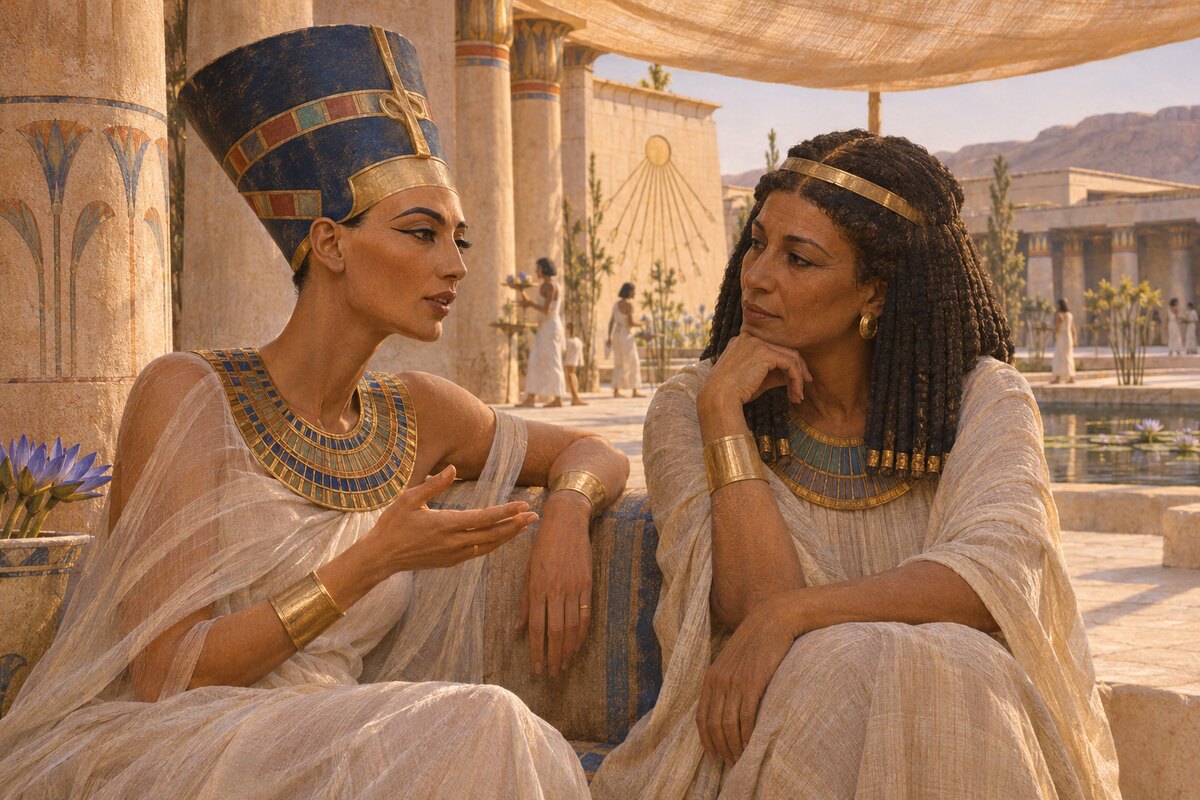
If Tadukhepa became Nefertiti, she could have acted on her own political judgment. An alliance with an influential Egyptian woman who knew the court would have been a natural step. Tey could have been that woman. In this reconstruction, their relationship arises from a decision by Nefertiti herself to bring Tey into her confidence.
Such an alliance could have given the foreign princess access to local networks and knowledge of court practice. For Tey, proximity to the queen could have been a source of influence in its own right. For Ay, the relationship might have provided additional opportunities to strengthen his position. The two women would thus have helped shape the fortunes of other courtiers through an alliance of their own making.
No document records such an agreement, and we do not know who initiated the relationship. The reconstruction nevertheless accounts for the monuments and titles without assuming that Ay was Nefertiti’s father. It also gives both women a role in forming the alliances on which court politics depended.
10. Influence beyond written orders
If Tey held political influence in her own right, where are her orders, diplomatic letters, or administrative documents? The form of the Egyptian state and the character of the surviving sources matter here. Supreme formal authority belonged to the pharaoh. Even Nefertiti, in an exceptional position, operated within a system that formally attributed decisions chiefly to the king.
Political influence and the right to issue orders are different kinds of power. A person can influence appointments, form alliances, and shape a ruler’s decisions without leaving orders in their own name. This distinction matters particularly for women in a society where most formal offices and official inscriptions were associated with men.
The absence of orders issued by Tey limits what we can say about her specific actions. Archaeology still gives us a sense of her unusually high standing, and images of Nefertiti show how far a woman’s authority could extend under Akhenaten.
11. Nefertiti’s place in Akhenaten’s religious order
Amarna monuments portray Nefertiti in a position of exceptional religious and political importance. She takes part in ceremonies beside Akhenaten, makes offerings to the Aten in her own right, and appears in scenes that place the royal family at the centre of relations between the deity and society. Some images even show her overcoming Egypt’s enemies, a role traditionally reserved for the king.
Nefertiti became one of the chief figures representing royal power in the new religious system. Her role in conceiving Akhenaten’s reform remains uncertain, while her participation in public religious life is well attested.
If she was Tadukhepa, a foreign princess who came to Egypt as part of a dynastic agreement kept her standing through a change of ruler and went on to become a central figure in a new state religion. Such a rise could have demanded considerable political skill. In that setting, the proposed alliance with Tey makes sense. A queen seeking authority of her own needed people she could trust, and those allies could come from beyond her family.
12. Does Egyptian ancestry better explain the evidence?
The case for Egyptian origins draws on real evidence: Egyptian names among Nefertiti’s relatives and associates, the titles of Tey and Ay, and connections among leading families. Each piece of evidence tells us something about her world, but an Egyptian name can be acquired, a caregiver need not share her charge’s origins, and court rank and the title ‘God’s Father’ establish no direct link of paternity.
To derive Nefertiti’s parentage from these facts, one must suppose that Ay fathered her, that an unknown earlier wife was her mother, that Tey’s role arose through family care rather than a later court relationship, and that Nefertiti’s ties to the Egyptian elite came through birth rather than through marriage and political activity. Each step may be possible. Together they amount to a reconstruction whose genealogy remains unverified.
The Mitannian hypothesis starts with a named candidate and a documented life. Tadukhepa existed. We know her origins, her father, and the circumstances of her first marriage. Tushratta called her Akhenaten’s wife. Her subsequent life under that name is unknown. Separately, we know Nefertiti was Akhenaten’s Great Royal Wife and that her origins remain uncertain. Were these two documented royal wives the same woman?
The number of assumptions matters less than how much evidence each can explain. The Mitannian hypothesis has a fuller independent biography for its candidate. The identification itself depends on how well it accounts for chronology, titles, and the positions of both women. That calls for further research. What can already be said is that it brings together records of two attested women at the same royal court. That gives the proposal a firm historical starting point.
13. A possible sequence of events
The known events and proposed connections can be arranged as follows.
- A Mitannian princess. Tadukhepa is born into the royal house of Mitanni. Her father Tushratta concludes a dynastic agreement with Amenhotep III and sends his daughter to Egypt. Diplomatic correspondence documents this stage.
- A change of pharaoh. After Amenhotep III dies, Tushratta’s letters identify Tadukhepa as a wife of Amenhotep IV.
- A new Egyptian name. As she takes her place in the new ruler’s household, Tadukhepa may have received the name Nefertiti. No direct record of such a change has been found.
- Political alliances. Nefertiti strengthens her position at court, possibly through her closeness to Tey. Inscriptions attest their relationship. The queen’s initiative is part of our reconstruction.
- The rise of Nefertiti and Tey. Nefertiti holds the title of Great Royal Wife and plays a major role in Akhenaten’s religious reform. Tey receives court honours and appears in TA 25 as a woman of high standing with titles of her own. The monuments document both positions.
- Ay’s position strengthens. His wife’s proximity to Nefertiti may have helped increase his influence, as Roehrig proposed. This account can explain his court position without assuming paternity.
The sequence shows how a foreign princess might have become one of Egypt’s most influential women. Much of it is recorded directly in the surviving sources. The remaining transitions can be stated as specific questions for further study.
14. What evidence could settle the question?
The strongest confirmation would be a document directly connecting the names Tadukhepa and Nefertiti. It might be an inscription recording the princess’s renaming, a diplomatic letter using both names, or a record of a change in her position at court.
The chronology matters just as much. The last references to Tadukhepa need to be compared with the earliest securely identified images and inscriptions of Nefertiti. A compatible chronology would preserve an important basis for the hypothesis. Evidence that the two lives cannot fit together would weigh heavily against it.
For the Egyptian account, a genealogical record naming Ay as Nefertiti’s father would carry similar weight. No such document is currently known. The popularity of either reconstruction cannot substitute for a historical record.
Conclusion. Whom do we know better, Tadukhepa or Ay’s presumed daughter?
The origins of Nefertiti remain uncertain, yet we already have a documented woman who could have occupied her place. Her name was Tadukhepa. We know her father, her royal house, and the diplomatic history of her marriage. After Amenhotep III died, she was called the wife of the new pharaoh, Amenhotep IV. Then her name drops out of the sources. The same court gives us the figure of Nefertiti, the Great Royal Wife whose origins remain unknown. Identifying them would connect those two parts of a biography.
The evidence for Tey offers a way to reconsider a traditional objection to the Mitannian hypothesis. A court alliance could account for the closeness between the queen and her Egyptian caregiver. TA 25 gives Tey a visible standing of her own at court, and leaves room to reconstruct Nefertiti’s rise through her own political decisions.
The diplomatic record gives Tadukhepa a known family and a biography leading up to her marriage to Akhenaten. Her documented existence cannot establish that she became Nefertiti. There is, however, a difference between proposing that a documented royal wife took a new name and proposing that an unknown courtier’s daughter became queen. Both accounts deserve scrutiny. Familiarity and expectations about the origins of an Egyptian queen should carry no special weight.
That is why the identification of Tadukhepa with Nefertiti belongs at the centre of the discussion as a reconstruction with a documentary foundation of its own. Future finds may show that Nefertiti was born in Egypt. They may also show that Tushratta’s daughter and Akhenaten’s Great Royal Wife were one woman. For now, the evidence gives us good reason to ask:
Are we reconstructing a daughter of Ay when the record has already preserved the name, family, and marriage of another woman, Tadukhepa?
If she did become Nefertiti, hers would be the story of a princess who entered a foreign royal household, built political alliances there, gained power in her own right, and became one of the best-known queens of the ancient world.
The first article on Tadukhepa, Nefertiti, and Sarah →
Sources and further reading
- William L. Moran. The Amarna Letters. Johns Hopkins University Press, 1992. EA 19, EA 20, EA 27, EA 28, and EA 29 are the principal written sources for Tadukhepa’s marriage. English translation.
- Anson F. Rainey. The El-Amarna Correspondence. Brill, 2015. A scholarly edition of the diplomatic correspondence with philological commentary. Open source.
- Janne Arp-Neumann. Amarna: Private and Royal Tombs. UCLA Encyclopedia of Egyptology, 2020. A study of the Amarna tombs, including the possible joint monument of Ay and Tey. https://escholarship.org/uc/item/0227n3wp
- Norman de Garis Davies. The Rock Tombs of El Amarna, Part VI, 1908. Publication of the reliefs and inscriptions of tomb TA 25. Open source.
- Catharine H. Roehrig. The Eighteenth Dynasty Titles Royal Nurse, Royal Tutor, and Foster Brother/Sister of the Lord of the Two Lands. Doctoral dissertation, 1990. A study of royal nurses and tutors. Open source.
- The Routledge Companion to Women and Monarchy in the Ancient Mediterranean World, 2020. Discussion of Nefertiti’s position, her proposed descent from Ay, and the Amarna royal family. Open source.
- Friederike Seyfried (ed.). In the Light of Amarna: 100 Years of the Nefertiti Discovery. Staatliche Museen zu Berlin, 2012. A catalogue of Amarna-period objects and historical reconstructions. Open source.
- Egyptian Museum and Papyrus Collection, Berlin. The Queen – Who Was Nefertiti? An overview of the surviving evidence and hypotheses about her origins. https://www.smb.museum/en/museums-institutions/aegyptisches-museum-und-papyrussammlung/collection-research/bust-of-nefertiti/the-queen/
- Athena Van der Perre. The Year 16 Graffito of Akhenaten in Dayr Abū Ḥinnis: A Contribution to the Study of the Later Years of Nefertiti. Journal of Egyptian History, 7, 2014, 67–108. https://doi.org/10.1163/18741665-12340014